
Sessions
- Introduction to Plants and Insects - naturalist
- Objective: Learn basics of plant and animal identification
- Food webs, habitat, observation - naturalist & creative
- Objective 1: Gain understanding of food web and ecological roles of plants and insects
- Objective 2: Build on skills of observation and description for plants (visual and written)
- Insect id skills and recording - naturalist & creative
- Objective 1: Further ID skills linking recording and habitat
- Objective 2: Skills of observation and description for insects (visual and written)
- Creatives
Session 1. Introduction to Plants and Insects
Objective: Learn basics of plant and animal identification
Inside?
1. Favourites - ice breaker activity
- ‘Ice breaker’ activity, note answers on white board (10 mins)
- What is your favourite plant, animal, bird, insect ?
- Stand up and organise students into kingdom groups, Plant, Animal, Fungi, (Mineral(?))
- Ask each in turn What plant, creature or fungi do you like or have an affinity with?
2. Why identify?
- Why do we need to identify plants, animals, birds and insects? (5 mins)
- 1.7 million species
- Scale of diversity, numbers: eg over 1000 bryophytes in UK
- Species arranged into families eg 30 different buttercups.
- What is a species?
- What is a population?
3. What makes a “”?
- Discuss what makes a - (10 mins)
- ‘Plant’ Leaves, roots, stem, flowers, green? Algae – simple plants
- ‘Insect’ Hard exoskeleton: ants, bees, beetles, spiders
- ‘Invertebrate’ no backbone: insects and also worms, slugs
- ‘Vertebrates’ have a backbone: mammals, amphibians, lizards
- ‘Fungi’ grow like plants, but chemical make up more like animals
- Basic plant anatomy (10 mins) – examples: leaves – holly, grasses/rushes, twigs - willow/hazel with catkins, roots and flowers – dandelions. using ID keys
- Use potted plants as examples, plus collected samples Diagram
- Basic insect anatomy (10 mins) – examples Diagram
4. What am I? game (10 mins)
Outside
Apply knowledge
1. Plants (30mins)
- Split into groups of 3-4
- Explain plant ID equipment - keys/hand lenses
- Talk through goals of the ‘hunt’ – find 2 or more plants to identify per team
- Send out for hunt
2. Insects (30mins)
- Groups of 3-4
- Explain bug ID/collection equipment – pooters, sweet nets, pots
- Talk through goals of the ‘hunt’ – find 1-2 insects to identify per team
- Send out for hunt
- Wrap up – reflect, and answer any questions
Note if not possible to go outside
1. Species groups: building on the ID quiz (20 mins)
Grasses Rushes and Flowers ‘hands on’ quiz style, several different plants and insects at 4 stations, to ID and talk about different structures, in small groups or individually.
- Grasses, Rushes and Sedges
- Umbellifers, violets, speedwell
- Docks, sorrels and plantain
- Clover, thistle, buttercup and dandelion
- Mosses, ferns, lichens….
Session 2. Food webs, habitat, observation
- Objective 1: Gain understanding of food web and ecological roles of plants and insects
- Objective 2 Build on skills of observation and description (visual and written)
Recap
- Recap on previous session, introduce creative, outline
- Quickfire quiz on plant and insect anatomy. (10 mins)
Split into 2 groups (50 mins in each)
Group 1 with Creative
Build on Plant ID skills through drawing and describing.
Plants: Outside or pre-collected. Find four different plants (or more), 2 grasses, two flowers/’broadleaved’
- Describe - write down and draw the key features of the plants
- Plant shape (tall, rosette/flat, twiggy/woody, branched)
- Leaf colour (dark, light, green or ‘other’)
- Leaf texture (rough, shiny, veined, hairy)
- Leaf shape (round, divided, hand/palmlike, leaflets: how many?)
- Flowers - colour, shape/number of petals
- Flowers arrangement on the stem, one large flower single stem, lots of small florets
Group 2 with Naturalist
1. Ecological Webs discussion (10 mins)
- What do we use plants for?
- Food
- Useful stuff – rope, cloth, paper…
- Medicinal plants..
- Other Function – social: Play surface, trees to climb, to look nice
- What do animals and insects use plants for?
- Wasps make paper nests out of wood
- Mice make nests out of grasses
- Bees use pollen and nectar to make wax to house and honey to feed their grubs
- Birds, nests out of twigs moss grass
- What do plants need to grow? Sunlight to create sugars from CO2 in the air and water and nutrients from soil to grow and produce leaves, flowers, seeds and roots
- What do insects eat? Plants, other insects….
- What eats Insects? Birds, mammals
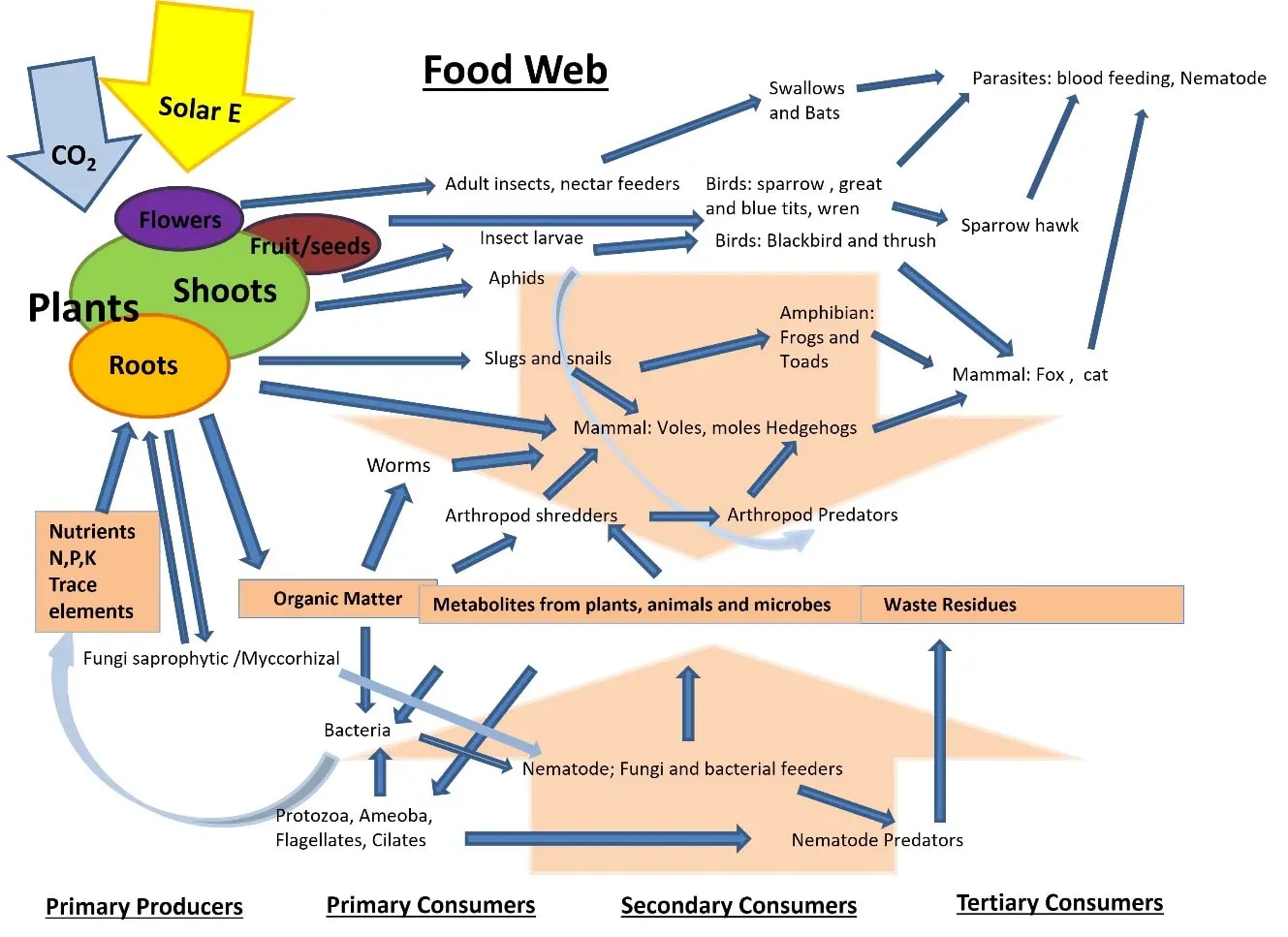
2. Draw a web of life activity (15 mins)
In groups (2-3) Draw a web of life…ecological web using examples [Use chalk, charcoal, string, make a web of life outside]
3. Habitat (5 mins)
Explain and discuss habitat – somewhere something has all that it needs to thrive: food, water, shelter.
4. Find habitat 10 mins
Split into groups (3-4) Ideally greenspace with different habitats (walls, hedge, grass, woods).
- In groups look for different habitats.
- Describe what species are or could be living in them – lichens, mosses, plants, fungi, insects, spiders, where might mammals live?
- Recap and share 2 group activities.
Session 3. Insect ID skills and recording
- Objective 1: Further ID skills linking recording and habitat
- Objective 2: Skills of observation and description (visual and written) for Insects
Recap
- Recap on previous session
- Quickfire quiz on plant and insect anatomy. (10 mins)
Group 1 with Creative
Build on Insect ID skills through drawing and describing
- Find different insects (with nets)
- Draw and make a note of key features:
- How many wings
- Wing shape and colour
- How many legs
- Body shape
Group 2 with Ecologist
Compare habitats & count diversity
Working in groups (2-4)
- Find two different habitats to compare species numbers and discuss why there is a difference. School garden? Hedgerow? Neighbouring field or woodland? Even a wall with ferns, lichens and mosses. (20 mins)
- Introduce idea of quadrats or transects to quantify the data collected. (30 mins)
- Count species in a low diversity area and compare with a section of Hedgerow where diversity is easier to see. Measuring species numbers and vegetation height
- Walk around school ground (or another safe habitat) to see how many species and habitats can be recorded in an area.
Recap and share 2 group activities (10 mins)